A Shopify store owner looking for SEO help gets pitched from two sides: the Shopify App Store lists 1,208 SEO apps (as of November 2026), and agencies send cold emails offering to improve rankings. Both pitches tend to skip the SEO features Shopify already builds into every store.
That leaves five realistic options: Shopify’s built-in tools, an SEO app, a one-time project with a Shopify Partner (a freelancer or agency listed in Shopify’s own directory), an ongoing freelancer, and an agency. They differ on cost, the work each covers, and the size of store each suits. findanseoagency.com compares what SEO agencies charge, and across these options the cost runs from nothing to several thousand dollars a month. The bigger difference is the kind of work each option can do. Software can handle repetitive work, such as writing alt text for 2,000 product images. It can’t decide which collection and product pages your store needs, and those pages are what show up when shoppers search. The copy apps do write can also miss the words shoppers actually type.
Shopify SEO app vs freelancer vs agency, side by side
| Option | Typical cost | What it covers | Who it fits |
|---|---|---|---|
| Shopify built-in tools | $0 beyond your Shopify plan | Sitemap, canonical tags, robots.txt, product structured data, speed basics, editable SEO fields | Every store; enough on its own for new stores with small catalogs |
| SEO app | Free to about $100/month for most; a few up to $345/month | Bulk alt text, meta tags, redirects, audits | Catalogs too large to edit by hand |
| Shopify Partner project | On the directory’s first page, most starting prices run $100 to $1,000; the highest range shown is $3,500 to $25,000 | One defined job, such as a theme fix or an audit | Stores with one technical problem |
| Freelancer | About $1,350/month on average (Ahrefs poll) | Collection and product copy, articles, some technical work | Stores with sales that mainly need steady writing |
| SEO agency | Most commonly $500 to $1,000/month; average $3,209/month (Ahrefs poll) | Keyword research, content, links, technical work, reporting | Stores with sales and search demand that need all of it |
Shopify Partner Directory prices cover everything a partner sells, often including whole store builds, so treat them as a rough guide. The freelancer and agency figures come from an Ahrefs poll of 439 SEO providers in general, in a post last updated in August 2024, and e-commerce specialists weren’t measured separately. Two things push the agency average above the most common range. Roughly a quarter of agencies charge several thousand dollars a month or more, and Ahrefs worked out the average as if every provider charged the top of its price range, which makes the average higher by design.
A freelancer is usually enough when the store needs one kind of work done steadily, such as new collection pages and product copy each month. An agency adds several kinds of work at once. Shopify’s Senior SEO Lead, Kyle Risley, has pointed out that the stores winning in search “target MORE keywords because they have dedicated keyword research teams that find new terms to target with collection pages or articles,” and “earn MORE links because they have bigger PR budgets.” findanseoagency.com’s SEO pricing breakdown explains what drives these prices, and its comparison of agencies, freelancers, and in-house hires goes further into the choice between people.
What does Shopify already do for SEO?
Most of the technical SEO that apps advertise is already running in your store. According to Shopify’s SEO overview and related help pages, every store gets:
- a sitemap.xml file listing every product, page, collection, and blog post, so search engines can find them
- canonical tags, which tell search engines which address is the main one when the same content appears at more than one URL
- a robots.txt file, which tells search engines which pages to skip; Shopify’s default version already hides filtered and sorted versions of collection pages, which only repeat the same products
- title tags generated by the theme
- product structured data (schema markup) built into Shopify themes, which lets search results show price, availability, and reviews
- an SSL certificate, on by default
- speed basics: a content delivery network, automatic image optimization, and minified code (web performance guide)
What Shopify leaves to you is the writing. Every product, collection, page, and blog post has fields in Shopify admin for its title tag, meta description, and URL, and every image has an alt text field. Risley summed up the split in a December 2024 Q&A with merchants: “Shopify handles a bunch of stuff like crawling and indexing signals, sitemap generation, etc in the background. You just need to focus on building awesome pages and promoting them.”
Shopify’s free Autopilot tool now suggests SEO edits too, overlapping with some paid apps. Shopify announced the feature on October 28, 2026. Autopilot SEO suggests page titles and product descriptions and publishes nothing until you approve it. It is rolling out gradually, so some stores don’t have it yet.
What can a Shopify SEO app do, and what does it cost?
The App Store’s SEO category sums up the job as “Add alt text to images, fix broken links, and create meta tags.” Several app types sell features Shopify already includes.
| App type | What it does | What Shopify already covers | Price range (App Store, November 2026) |
|---|---|---|---|
| All-in-one SEO suite | Audits, meta tags, alt text, redirects, schema | Sitemap, canonical tags, product schema, editable SEO fields | Free plans common; paid $9.99 to $249.99/month, most $14.99 to $99/month |
| Image and speed optimizer | Compresses images, writes alt text | Image optimization, content delivery network, minified code | Free plans common; paid $5 to $99/month |
| Schema (structured data) app | Adds or extends schema markup | Product schema in themes | Dedicated apps from free plans up to $399/year; also included in some free all-in-one suites |
| AI product description writer | Drafts descriptions and meta tags in bulk | Autopilot SEO suggestions (rolling out) | Free plan; paid $19 to $249/month |
| AI blog writer | Drafts and publishes blog posts | Blog editor only | Free plans; paid $8.99 to $54/month |
| AI visibility app | Promises to get products into ChatGPT, often by adding special files meant for AI tools | Shopify shares eligible products with ChatGPT automatically (see the AI section) | Several free; paid $9.99 to $345/month |
| Redirect manager | Bulk redirects, broken link fixes | URL redirects in Shopify admin | $2.90 to $4.90/month |
Most of these prices come from the category’s first page, and they change often. For a small store, the main risk is paying every month for an app that changes nothing.
An app saves time when your catalog is too big to edit by hand, because it can fill in alt text and meta tags across the whole catalog at once. A store with 20 products can write its own alt text and meta descriptions in Shopify admin.
What SEO apps can’t do, and what they can break
Risley’s view, in a Shopify blog post from September 2024, is that an app can’t make up for missing pages: “Fundamental SEO success starts with creating the right pages (products and collections), labeling them clearly, and consistently delivering an exceptional experience to users,” he said. “If you’re not doing that, then installing an app won’t improve your SEO performance.”
-
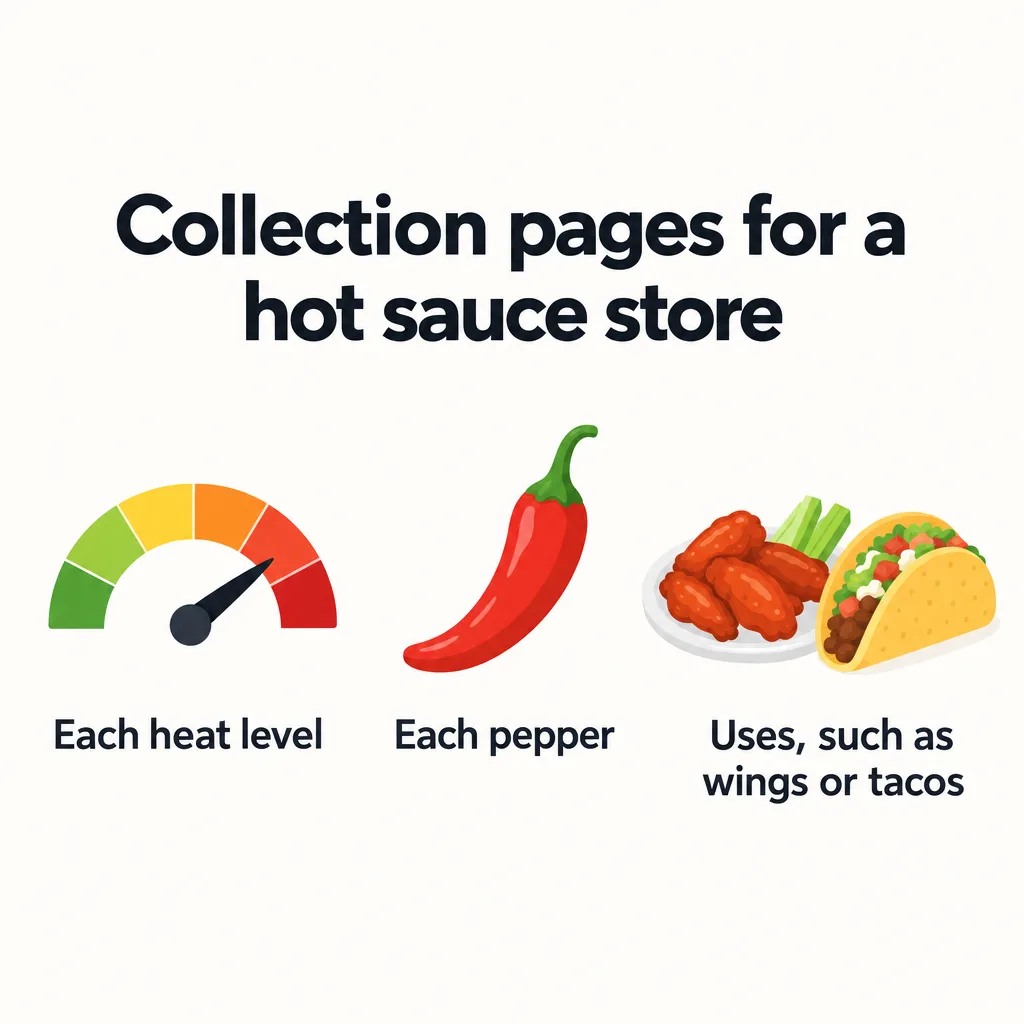
Choosing which collection pages to build. A collection page is the page that can show up when a shopper searches for a type of product, such as “mild hot sauce.” Risley’s example is a hot sauce store, which should have collections for each heat level and each pepper, and possibly for uses such as wings or tacos.
-
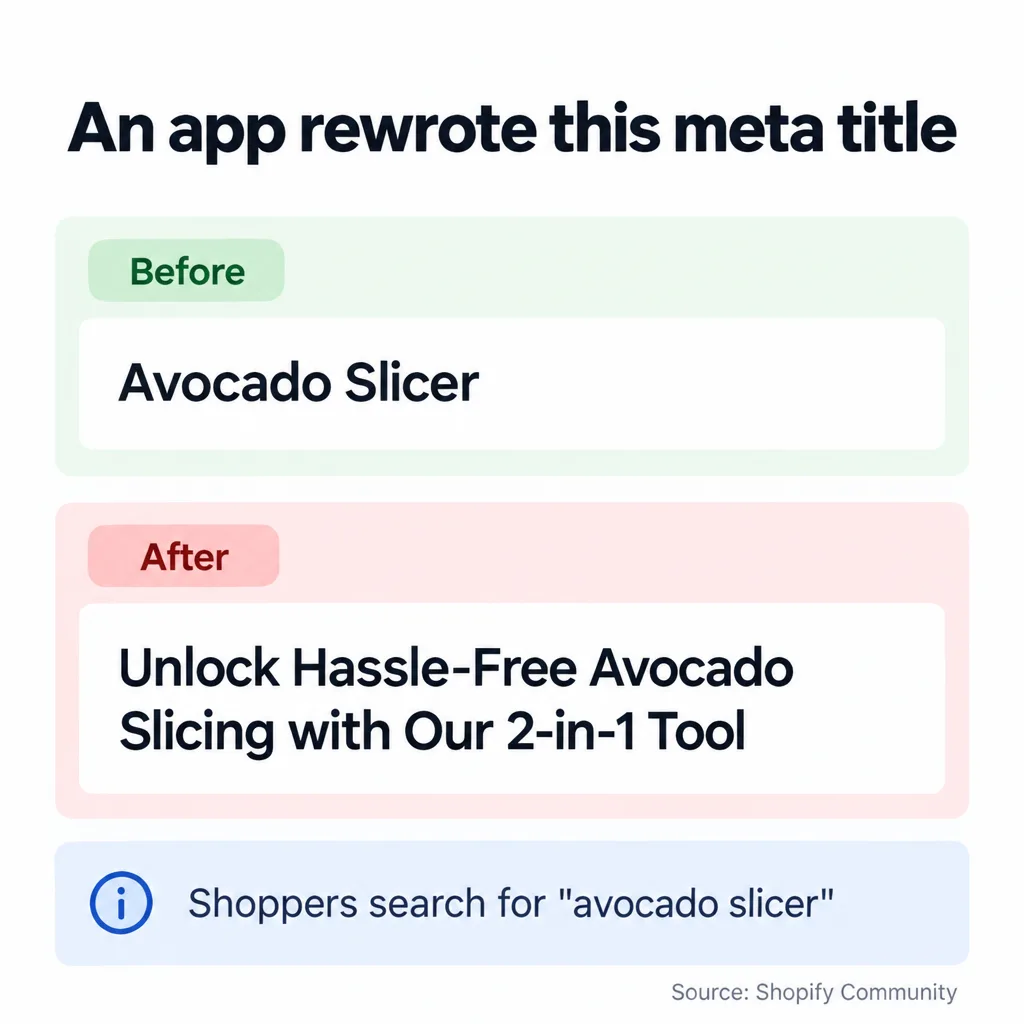
Writing copy that matches what people search. One store owner tested an app that “changed the Meta Title from ‘Avocado Slicer’ to ‘Unlock Hassle-Free Avocado Slicing with Our 2-in-1 Tool’”. Shoppers search for “avocado slicer,” and the new title buried those words in a sales line.
-
Earning links from trusted sites in your niche, which comes from outreach, partnerships, and press.
-
Outranking Amazon and Etsy on the same products. Risley told a merchant in that position: “If you’re selling products that are also sold on large 3P marketplaces, it can be hard to outrank them and it’s not something an app is likely to be able to help you with.”
-
Changing how the theme links to products. Some themes link products in collection grids to a second address for the same product, such as /collections/sauces/products/ghost-pepper instead of /products/ghost-pepper. Shopify’s developer documentation warns theme builders to consider the SEO effect of the same content on two URLs. Canonical tags point search engines to the main address, but making the grid link to the main address takes an edit to the theme’s code, which is a developer’s job.
-
Editing robots.txt. Shopify calls this “an unsupported customization,” suggests hiring a Shopify Partner, and warns that mistakes “can result in loss of all traffic.”
Some apps also edit your theme’s code, and those edits can outlast the app:
- Extra title tags. Shopify’s SEO FAQ says an SEO app may add its own theme files that generate title tags, and that those files should be reviewed when a page’s title tag is missing.
- A slower store. Apps that load files on your storefront can slow it down.
- Leftover code. Shopify warns that “uninstalling an app doesn’t automatically remove its code from your theme.” One merchant with multiple meta titles and descriptions thought the cause was “multiple SEO Apps that has left residual code after uninstalling.”
- Overlapping apps. Pick one SEO app per job, so only one app is editing each field.
Many apps grade the store with an SEO score, and raising it mostly means filling in the fields the app checks. A perfect score says nothing about whether shoppers search for your products or whether your pages beat the ones already ranking.
Do ChatGPT Shopping and Google AI Mode change the choice?
For an eligible store, Shopify already shares your product listings with ChatGPT, Microsoft Copilot, and Meta automatically, through a product database it calls Shopify Catalog. Eligible means, among other things, that the store sells to customers in the United States and has its terms of service, privacy policy, and refund policy filled in. Google AI Mode and Gemini are different: they are still rolling out, and they need a Google Merchant Center account connected to your store.
None of this needs a special app or file. Google’s guidance on AI features says: “You don’t need to create new machine readable files, AI text files, or markup to appear in these features.”
Your remaining job is the product data itself. AI assistants read the same titles, descriptions, and specifications that help a product page rank in Google.
Getting your brand named in AI answers is a separate job from having your products listed. When someone asks ChatGPT which stores sell good hot sauce, the stores it recommends tend to be the ones mentioned in articles and on the sites AI assistants already cite. Earning those mentions is part of AI search, which is what SEO has become, and an agency can help with it. findanseoagency.com’s guide to getting recommended by AI search explains how.
What to fix on your Shopify store before paying for anything
Most of the work that moves rankings for a small store costs nothing, and all of it happens in Shopify admin and Google’s free tools.
- Take the store out of trial and password mode. Search engines don’t index trial stores, and a password hides your sitemap.
- Submit your sitemap (yourstore.com/sitemap.xml) in Google Search Console, Google’s free tool for seeing how your store appears in search.
- Build a collection for each product type, feature, or use shoppers search for, and put the important ones in the main menu.
- Write your own product descriptions. Shopify recommends at least 250 words per page and warns against copying manufacturer descriptions that other sites already use.
- Write title tags in the words shoppers type, in under 60 characters, with meta descriptions under 160.
- Fill in your store policies, then check Sales channels > Agentic in Shopify admin for an “Ineligible” warning, which means your products aren’t being shared with AI assistants.
- Connect Merchant Center, which Google AI Mode requires. The Google & YouTube sales channel is the simplest way to get your products into it.
- Prune your apps. Remove storefront apps you don’t need, keep one SEO app per task at most, and ask the developer of any app you’ve uninstalled how to remove its leftover code.
Can a Shopify store rank for informational searches?
Searches like “how to make soap,” where someone wants to learn rather than buy, aren’t reserved for blogs and publishers. A Shopify store can rank for them with articles that answer questions about the products it sells. Shopify’s own guidance lists informational searches as a search type and asks for blog posts of at least 500 words, and Risley’s rule of thumb is “to publish articles that answer informational queries about the products you sell.” Competing with big sites this way takes effort. In 2021, the SEO for a tea store with 30 to 40 products asked Google’s John Mueller for advice. Mueller said that ranking competitively against “really big sites” with blog posts is “really hard work,” and told them, “It sounds like you’re doing a lot of things right.”
When is it time to hire an SEO agency for a Shopify store?
Paying for help makes sense once your store has sales, people search for what you sell, and the page and content work has outgrown your time.
- Shoppers search for your products. A merchant in a forum thread about hiring put it first: “SEO will work if people ‘search’ for products that you sell. Do they?” If they don’t, paid social may suit your products better.
- The writing backlog is bigger than your time. You need more collection pages, product copy, and articles than you can write while running the business.
- You have a theme problem no app fixes, such as duplicate product URLs, a robots.txt change, or leftover code nobody can trace. A one-time Shopify Partner project may be enough.
- Your traffic is large enough for small gains to count. Risley noted that “a 1% lift on a site with 1M monthly visits is meaningful and measurable. A 1% lift on a site with 50 visits is not.” Shopify’s SEO overview gives a usable floor: below 1,000 visitors a month, it suggests focusing first on social media, content, and outreach.
Hiring can wait if the store has no sales yet or the checklist above isn’t done. findanseoagency.com’s guide to SEO without an agency is written for local businesses, but its signs for when to stop working alone apply to store owners too.
When you do hire, give the person only the access the job needs. For Search Console, Google advises granting read access during an audit, which lets them see your search data without changing any settings.
Which SEO agencies work with Shopify stores?
1Digital Agency and Inflow both sell SEO to e-commerce stores. 1Digital publishes package prices, while Inflow publishes only what it says effective SEO costs.
- 1Digital Agency: as of November 2026, its packages for stores selling nationally cost $1,499 to $5,999/month, with a six-month initial term. It also sells a ChatGPT service aimed at getting products cited and shown in ChatGPT’s shopping results. Shopify already shares eligible products with ChatGPT, so it is worth asking what the service adds beyond that.
- Inflow suits established stores with a larger budget. As of November 2026, its SEO page says the most effective services generally cost $3,000 to $5,000 per month. Inflow also does AI search work: it tracks how often a brand appears in answers from ChatGPT, Gemini, Google AI Overviews, and other AI assistants, and works on getting the brand cited. It does not list a service for getting product listings into AI shopping, which Shopify already handles for eligible stores.
What to do next
For most small Shopify stores, the next step is the checklist above, then new collection pages and articles about your products, with an app added only when a catalog-wide task gets too big to do by hand. If the signs point to hiring, findanseoagency.com’s guide to choosing an e-commerce SEO agency covers what the work should include, what agencies charge, and the questions to ask before signing.