
Short answer:
- Your SEO agency makes every change to your website.
- The AI search vendor measures how AI assistants answer your customers’ questions and sends recommendations to the SEO agency.
- Your company owns the accounts and the tracking data.
- One named person at your company settles disputes.
- Each vendor’s contract excludes the other vendor’s work.
- The AI search vendor starts as a pilot, with a date to decide whether to keep it.
Most companies don’t need a separate AI search vendor. findanseoagency.com’s position is that AI search is part of SEO, so a second vendor usually means paying twice for overlapping work. The case against hiring a second agency sets out why.
Some companies end up with two vendors anyway, for example because procurement requires it or because the current agency doesn’t do AI search work. Their work will overlap, and neither vendor is likely to say plainly where its job ends. The company has to draw that line itself and write it into both contracts.
How much does an AI search vendor’s work overlap with an SEO agency’s?
An AI search vendor’s work overlaps with an SEO agency’s almost completely. Both work on the same pages, the same site settings, and the same mentions of your company on other websites. Google takes the same view for its own search. Its guide to optimizing for generative AI says: “From Google Search’s perspective, optimizing for generative AI search is optimizing for the search experience, and thus still SEO.” Google also says a page needs nothing extra to appear in AI Overviews or AI Mode beyond what it already needs to appear in ordinary Google results.
AI search vendors often sell this work as GEO (generative engine optimization) or AEO (answer engine optimization). Both are other names for the same work.
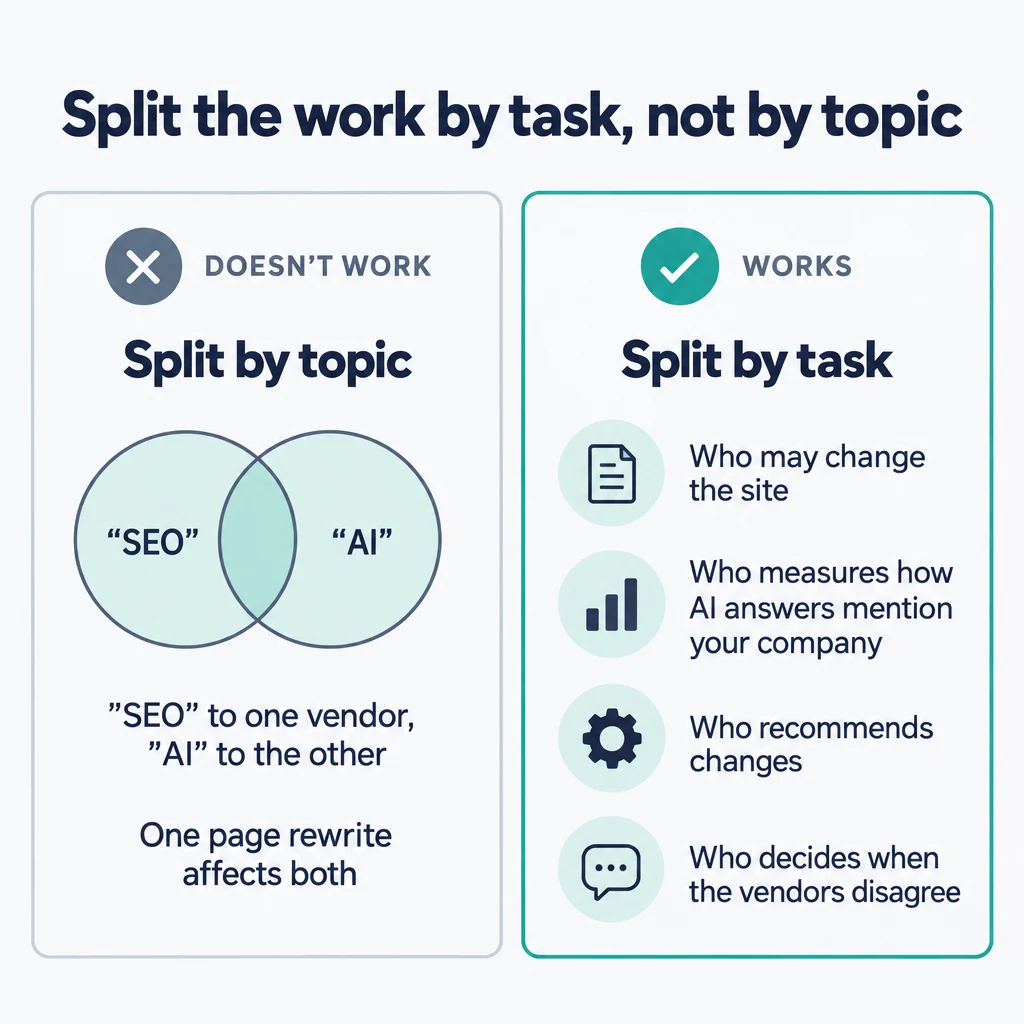
Because the work is the same, splitting it by topic, with “SEO” going to one vendor and “AI” to the other, doesn’t work. One rewrite of a page affects both where it ranks and whether AI answers use it. A split by task works better. It says who may change the site, who measures how AI answers mention your company, who recommends changes, and who decides when the two vendors disagree.
How to split the work between an SEO agency and an AI search vendor
In this split, each workstream has one vendor doing the work and one owner at your company.
| Workstream | SEO agency | AI search vendor | Your company |
|---|---|---|---|
| Changing pages, including location pages (copy, templates, internal links, structured data) | Does the work | Recommends in writing; no edits | Approves through normal review |
| Deciding what content gets written | Owns the content plan | Suggests topics from its prompt findings | Signs off the plan |
| Technical settings, including robots.txt, AI crawler access, and firewall or CDN bot rules | Owns the settings (with IT) | Flags problems; no changes | Owns the server and accounts |
| AI search audit | Receives the findings and responds | Delivers it once, at the start | Owns the report |
| Prompt tracking and diagnosis | Reads the results | Runs it, in your account | Owns the prompt list, tool account, and baseline |
| Off-site mentions (directories, review sites, published lists, discussion threads) | Keeps it if already in scope | Does it only where no other vendor does | Decides which vendor, in writing |
| Google Business Profile and review responses | Keeps it if already in scope; otherwise your existing listings vendor or central team does | Reports how AI answers describe locations | Owns every profile |
| AI visibility reporting | Reports its own work against the shared numbers | Reports its own work against the shared numbers | Owns the one shared report |
| Disputes between vendors | Raises them | Raises them | One named person decides |
Who can change your pages, content, and robots.txt
Only the SEO agency should change the site. Two vendors editing the same pages can undo each other’s work, because one rewrites a page for AI answers while the other rewrites it for rankings. Keeping all edits with one vendor also means one work log shows every change, with its URL and date. Google suggests asking any SEO, “Will you share with me all the changes you make to my site, and provide detailed information about your recommendations and the reasoning behind them?” (Do you need an SEO?). That question only has a clear answer when one vendor makes the changes.
The same goes for crawler settings. ChatGPT, Perplexity, and other AI assistants send crawlers, which are programs that visit your site so the assistant can show its pages in its search answers. If an assistant’s search crawler is blocked in robots.txt or a firewall rule, your pages stay out of that assistant’s search answers, whatever the AI search vendor recommends. OpenAI’s crawler documentation says sites that block its search crawler “will not be shown in ChatGPT search answers, though can still appear as navigational links.” The SEO agency should own these settings, and its SOW should say who must be told before they change.
What the AI search vendor is responsible for
The AI search vendor’s job is to find out how AI assistants answer your customers’ questions and tell the SEO agency what to change. It does this with a prompt list, which is a fixed set of questions your customers ask. Each month, the vendor puts those questions to assistants such as ChatGPT, Gemini, and Google’s AI Overviews, and records whether the answers cite or recommend your company. The first month’s results are the baseline that every later month is compared against.
Each recommendation the vendor sends to the SEO agency should name the page or setting, the change, and the reason. The SEO agency decides whether and when to make the change, and answers in writing.
The vendor can also work on off-site mentions: getting your company listed and mentioned on the directories, review sites, and published lists that AI answers draw on for your industry. It should take this on only where no other vendor already does it. If the SEO agency, or a PR, social, or influencer agency, already works on mentions, the work stays there unless your company decides in writing to move it.
What your company should own
Your company should own everything that needs to outlast either vendor. That means Search Console, Google Analytics, every Google Business Profile, and the AI visibility tracking tool account, with the vendors added as users you can remove. It also means the prompt list and the baseline. The baseline should be recorded before the SEO agency acts on any of the AI search vendor’s recommendations, so later results show what changed after the vendor started.
A natural choice for the person who settles disputes is whoever already manages the SEO agency. Without a named decision-maker, a disagreement about a page or a setting can stall, and both retainers keep billing while it does.
Who manages location pages, Google Business Profile, and review sites for a multi-location brand
For a multi-location brand, location pages, Google Business Profiles, and review sites affect both where each location ranks in Google and what AI answers say about it. Google’s generative AI guide says Google Business Profiles “can help your products and services to be visible in both AI responses and other Google Search results.” Location pages are pages on your site, so the SEO agency changes them like any other page. Google Business Profiles and review responses can stay with whoever manages them now, whether that is the SEO agency, a listings vendor, or a central team at your company.
The AI search vendor’s part is to report how AI answers describe each location and which review sites those answers draw on, and to send that report to whoever manages the profiles. Recommendations for location pages go to the SEO agency, like any other recommendation. Which review sites AI answers draw on differs by industry, so the report tells whoever manages the profiles which sites to focus on for your locations.
Who owns the AI visibility number?
When both vendors report an AI visibility number, the one to use is a single number your company owns. It measures how often AI answers cite or recommend your company across the shared prompt list, and it comes from the tracking account in your company’s name. Each vendor can report its own work against that number.
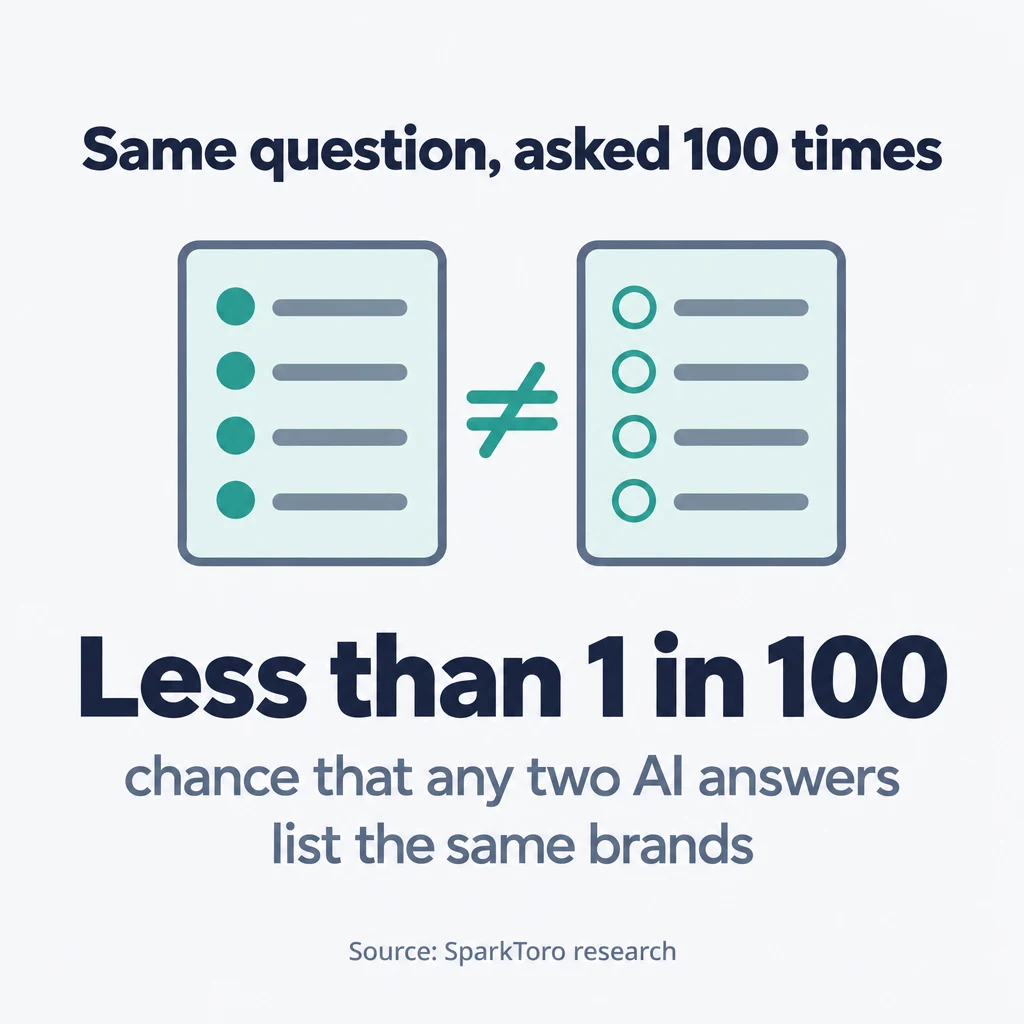
Two vendors measuring separately will usually give you two different numbers, and the gap can come from their tools and prompt lists rather than from either vendor’s work. AI answers vary from one run to the next. SparkToro’s research found that when the same question is asked 100 times, ChatGPT and Google’s AI almost never give the same list of brands twice: the chance of any two answers matching was less than 1 in 100. Many tracking tools also can’t see the questions real users type, so they run questions they write themselves (Digiday). Two vendors with two tools and two prompt lists are measuring two different things.
One shared report fixes that, as long as these are in place before the AI search vendor starts:
- One prompt list, agreed by both vendors and owned by your company. Any change to it is dated and approved by the named owner.
- One tracking tool account in your company’s name. Its results are the ones both vendors report, and results from a vendor’s own tool don’t replace them.
- One metric: the share of runs in which AI answers cite or recommend your company. SparkToro’s Rand Fishkin suggests that “visibility % across dozens to hundreds of prompts run multiple times is a reasonable metric.”
- One baseline, recorded before the SEO agency acts on any of the vendor’s recommendations.
Google’s own data gives both vendors a check that doesn’t come from either vendor’s tools. As of November 2026, most companies can use these two Google sources:
| Google source | What it shows | What it leaves out |
|---|---|---|
| Search Console’s generative AI performance report, available to all websites since August 31, 2026 | How often your pages appeared in AI Overviews and AI Mode, by page, country, device, and date | Clicks, and the searches people typed |
| Google Analytics’ AI Assistant channel | Visits from ChatGPT, Gemini, Copilot, and similar assistants | Visits from AI Overviews and AI Mode, which are counted with ordinary Google search visits |
These two sources and the shared prompt tracking together make up the AI visibility section of the monthly report. What an SEO report should include covers the rest of it.
How to run the AI search vendor as a pilot
A pilot gives the AI search vendor a fixed term, a defined scope, and a decision at the end, so the second contract doesn’t renew by default. The pilot’s SOW should set out:
- Scope. One region, one product line, or one group of locations, so results can be compared against the parts of the business not in the pilot.
- Deliverables. The baseline, the audit, monthly prompt tracking, and a set number of written recommendations to the SEO agency.
- Term. A stated end date, with the decision date set before any renewal or notice deadline. One month’s results aren’t enough to judge, because AI answers change from month to month. eMarketer, reporting Search Engine Land’s figures, puts the share of cited sources in Google AI Mode and ChatGPT that change month to month at 40% to 60%.
- Success measures, agreed before the start and taken from the shared report. One example is the change in AI visibility against the baseline in the pilot region, compared with the change over the same months in the parts of the business not in the pilot.
- A decision date, with the named owner responsible for the decision.
At the decision date, the named owner chooses one of these:
- Keep both vendors, with the boundary already in writing.
- Move the AI search work into the SEO agency’s scope, if the agency has shown it can do it.
- End the pilot.
What to write in the SOW or RFP
Each vendor’s SOW should say what that vendor does, what it does not do, where its work hands off to the other vendor, and who decides. The exclusions in one SOW should match the inclusions in the other, so that every task in the split appears in exactly one scope. In an RFP for the AI search vendor, attach a summary of the SEO agency’s current scope and ask each bidder to say where its proposed work overlaps it and how it would hand work off.
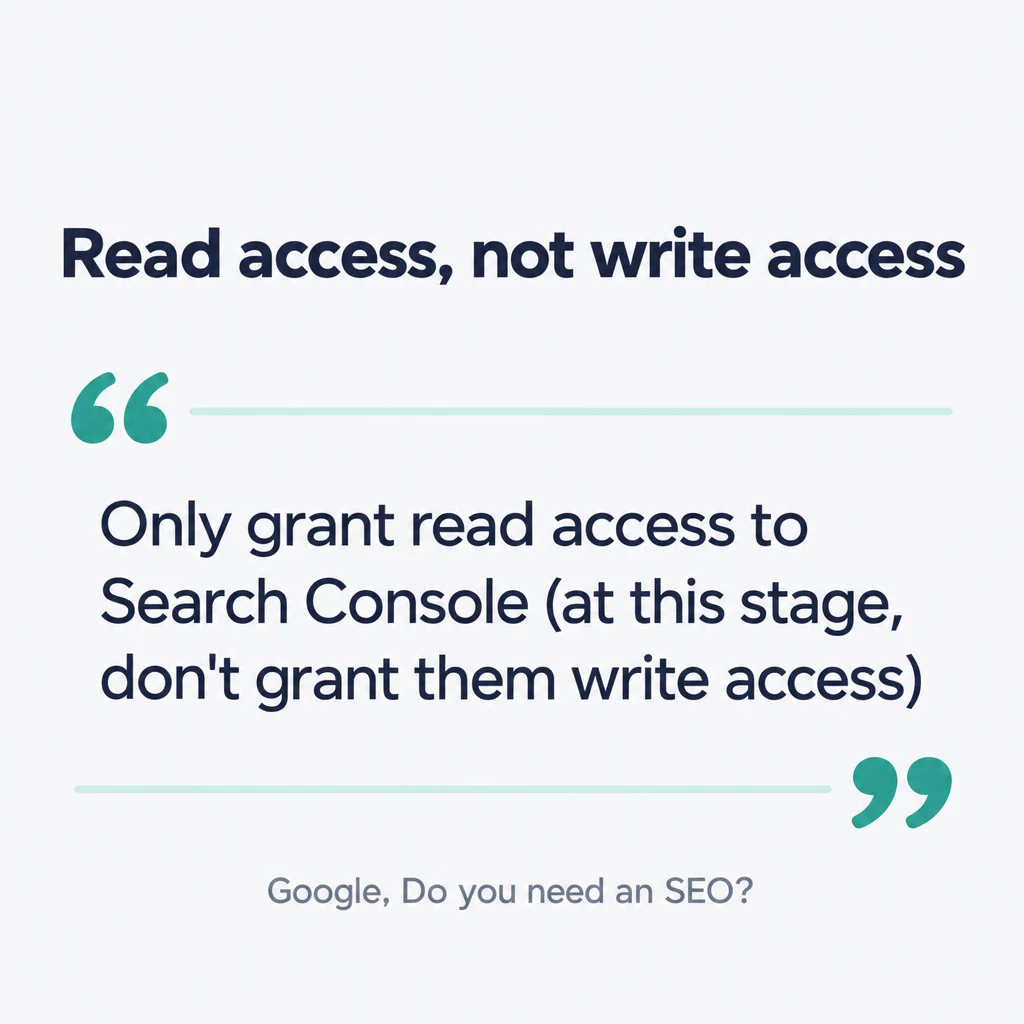
The AI search vendor needs to read your data, not change it. Google gives the same advice for any SEO offering an audit: “only grant read access to Search Console (at this stage, don’t grant them write access)” (Do you need an SEO?).
This wording is an example to adapt with your legal team, not contract language to sign as written. The bracketed items are placeholders.
In the AI search vendor’s SOW:
Exclusions. Vendor will not edit, publish, or remove content on [domain], change page templates or structured data, or change robots.txt, firewall, or CDN bot settings. Vendor will not request such changes directly from [Company] IT.
Recommendations. Vendor will deliver recommendations in writing to [SEO agency] and [named owner]. Each recommendation will name the page or setting, the proposed change, and the reason. [SEO agency] decides whether and when to implement it.
Access. Vendor will receive read-only access to Search Console, Google Analytics, and [SEO agency]‘s monthly work log, and user access to the AI visibility tracking account owned by [Company].
Data. The prompt list, tracking account, raw exports, and baseline belong to [Company] and will be delivered in [format] at the end of the term.
Reporting. Vendor will report AI visibility only against the shared prompt list and baseline in [Schedule X].
In the SEO agency’s SOW, or an amendment to it:
Site changes. Agency remains responsible for all changes to pages, content, and technical settings on [domain], including AI crawler access.
Response to recommendations. Agency will respond in writing to each recommendation from [AI search vendor] within [number] business days: implement, schedule, or decline with a reason.
Notice. Agency will notify [named owner] at least [number] business days before any change to robots.txt or bot settings that affects AI crawlers.
Reporting. Agency will report AI visibility against the shared prompt list and baseline in [Schedule X], and will list every changed URL and date in its monthly work log.
In both:
Decisions. Where [SEO agency] and [AI search vendor] disagree, [named owner, by role] decides, and both vendors will follow that decision.
Scope changes. Any task moved between [SEO agency] and [AI search vendor] will be recorded in a written change order that updates the scope and fee in both SOWs.
Duplicate charges. Where [named owner] finds the same task billed by both vendors, the vendor whose SOW excludes that task will credit the charge on its next invoice.
Term, notice periods, and renewal follow the company’s usual terms; what to check in an SEO contract covers those.
Signs you’re paying twice for the same work
Double billing between an SEO agency and an AI search vendor usually shows up on the invoices and work logs before anyone notices it in the results. Compare the two side by side each month and look for these signs:
- Two audits of the same site. Both vendors bill for a technical or content audit in the same period.
- Two tracking tools. Both vendors charge for prompt tracking or an AI visibility tool subscription.
- The same page billed as work by both vendors. The AI search vendor naming a page in a recommendation and the SEO agency then changing it is the normal handoff. Both vendors billing for editing or rewriting the same page is not.
- Rewrites of recently changed pages. The AI search vendor proposes rewriting pages the SEO agency has just rewritten, without saying what is different about the new version.
- An AI search surcharge from the SEO agency. The agency charges extra for AI search work on pages it already manages.
- The same result claimed twice. Both reports take credit for the same rise in AI visibility. The named owner can check each claim against two records. The SEO agency’s work log shows which pages changed and when. The AI search vendor’s recommendations show which of those changes it proposed.
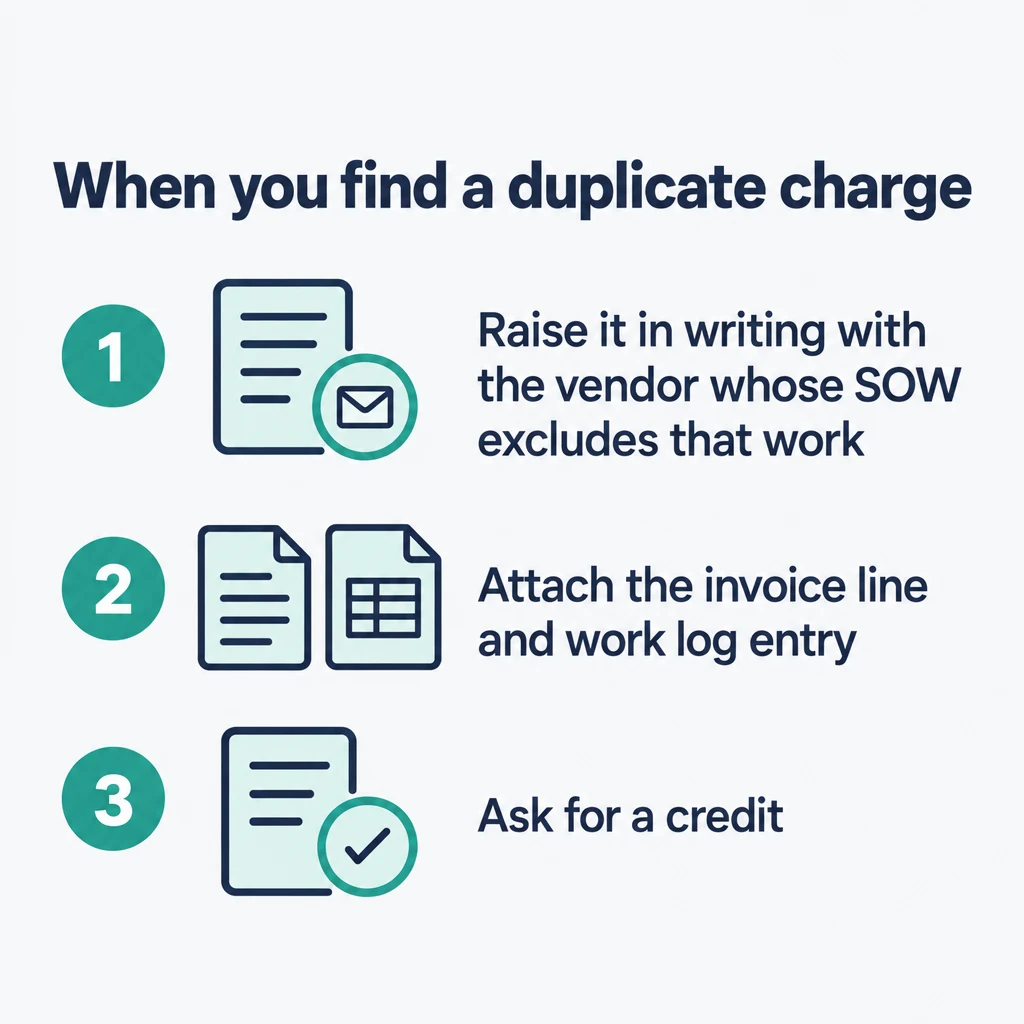
When you find a duplicate charge, raise it in writing with the vendor whose SOW excludes that work, with the invoice line and work log entry attached, and ask for a credit. When a task moves from one vendor to the other, for example off-site mentions moving from the SEO agency to the AI search vendor, revise the SEO agency’s scope and fee in the same change order. Otherwise the company keeps paying the agency for work it no longer does.
Vendors sometimes sell two tactics as work Google needs: llms.txt files (a file some sites add to describe their content to AI systems) and “chunking” (splitting pages into short, separate passages for AI answers). Google’s generative AI guide says that for Google Search, “you can ignore tactics like ‘chunking’ content, creating unnecessary AI text files (like llms.txt), or pursuing inauthentic mentions.” So neither vendor should bill for them as something Google Search requires.
A report of your “ranking position” in AI answers isn’t worth paying for either, because AI answers vary too much from run to run for a position to mean anything. Fishkin’s view is that “any tool that gives a ‘ranking position in AI’ is full of baloney.”
A tool that claims to use Google’s internal data isn’t worth paying for. Google says “No third-party tool has access to our internal ranking or AI systems,” so no vendor can see how Google picks the pages its AI answers cite. A vendor promising that AI answers will cite or recommend your company is also promising more than it can deliver.
What to do next
The first step is to rewrite both scopes, or the RFP, with the boundary in them, and to set up the shared report before the AI search vendor starts. If the AI search vendor hasn’t signed yet, vet it first. findanseoagency.com’s guide on how to choose an SEO agency for AI search lists the questions to ask any vendor pitching this work, including what it tracks, how it measures, and who owns the accounts.